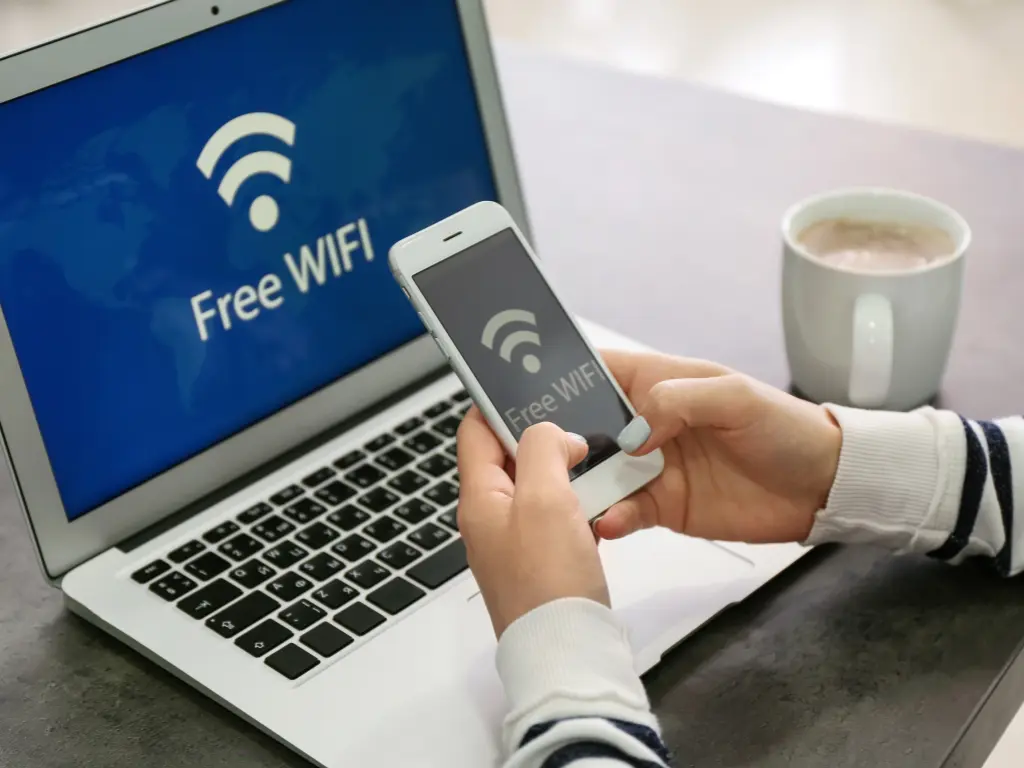
Walk into most small businesses in Central Florida and the guest WiFi name was decided in about eleven seconds. Usually by whoever unboxed the router, sometimes by the office manager who wanted it to look friendly on the card at the front desk. Almost never by anyone thinking about what that name broadcasts, to whom, and for how long.
I have spent more than 25 years in network security, the last 15 running a managed IT firm. In that time I have done hundreds of wireless walkthroughs across Orlando, Lake Mary, Sanford and Winter Park. I can usually tell you the tenant roster of an office park from the parking lot, because every business in it published its own name, its hardware vendor and its internal network layout over the air, on purpose, ten times per second.
Here is the core of it: the SSID is the one piece of your network you deliberately transmit to every stranger within a few hundred feet, continuously, forever. Every other control you own restricts what outsiders can see. The network name is the part you hand out. It deserves more than eleven seconds.
What an SSID actually is
SSID stands for Service Set Identifier. In plain terms, the SSID is the WiFi network name, the thing that shows up in the list when someone taps the WiFi icon on their phone. The 802.11 standard allows up to 32 characters, which is why “Harmony Guest Network” fits and “The Justice League of America Guest WiFi” does not.
Two details about SSIDs matter for security, and neither one is obvious to a business owner:
- The name is sent unencrypted. Your access point advertises the SSID in a beacon frame roughly ten times per second, and that beacon is not protected by WPA2 or WPA3. Encryption protects the traffic riding on the network, not the announcement that the network exists. Anyone with a laptop and a twenty five dollar adapter can read every SSID in range without attempting to connect to anything.
- The name travels with a hardware fingerprint. Alongside the SSID, each radio advertises a BSSID, the MAC address of that specific radio. The SSID is the human label, the BSSID is the serial number, and both get recorded.
So the working definition for a business owner: the SSID is public metadata about your company that leaves your building, cannot be encrypted, and is permanently harvestable by anyone who drives past.
What your network name tells someone standing in your parking lot
When I run a wireless assessment, the SSID list is the first thing I capture, before I touch anything else. It is free reconnaissance, and it usually gives up three separate categories of information.
1. It confirms who you are and where you are
“HarborPointDental-Guest” is not a network name, it is a label on a target. It tells anyone in range which radios belong to which business, with no guesswork. That matters more than people expect, because it turns an anonymous set of radio signals into a named organization that can be looked up, phished and physically located.
It also hands an attacker a ready made pretext. A caller who says “this is IT, we are pushing an update to HarborPointDental-Guest this afternoon” sounds legitimate to a front desk employee precisely because he used the real network name. The name is a trust token, and you published it. That is the same mechanism we covered in What Social Engineering Actually Looks Like Inside a Small Business: specific, verifiable detail is what makes a pretext work.
2. It names your hardware vendor, and therefore your vulnerabilities
Default SSIDs are worse than identifying names. “NETGEAR58”, “ARRIS-2F7B”, “linksys” and the various “SETUP-XXXX” patterns announce the manufacturer and often the model family. From there an attacker knows the default administrative credentials and the published vulnerability list for that device.
CISA makes this point directly in its guidance on securing wireless networks: leaving the SSID as the manufacturer default could allow an attacker to identify the type of router and possibly exploit known vulnerabilities in it.
3. It publishes your internal network map
This is the one that makes me wince most often. I regularly find SSID sets that look like this:
- ACME-Corp
- ACME-Guest
- ACME-POS
- ACME-CAM
- ACME-VOIP
That business broadcast its VLAN design to the street. Before touching a single packet, an attacker knows there is a separate network carrying card transactions, knows there are IP cameras and a voice system, and knows which radio to focus on. It is the network equivalent of labeling the keys on your keyring.
And all of it is being indexed, globally
The part most owners have never heard is that WiFi identifiers are not only readable locally. They are collected into searchable databases with coordinates attached. WiGLE has been cataloging networks submitted by wardrivers since 2001, and its database is searchable by SSID with mapped locations. It is public, free to query, and not going away.
The scale became clearer in 2024. Erik Rye and Dave Levin of the University of Maryland published work at the IEEE Symposium on Security and Privacy showing that an unprivileged attacker could abuse Apple’s WiFi based positioning system to assemble a worldwide snapshot of access point geolocations in a matter of days. Over a year they learned the precise locations of more than two billion BSSIDs, and demonstrated they could track access points that moved. (Rye and Levin, 2024)
After that disclosure, Apple documented an opt out: an owner can exclude an access point from Apple Location Services by changing the SSID so that it ends in “_nomap”. Google honors the same suffix. Sit with that for a second. The major platform vendors built an opt out whose only interface is the network name. Your SSID is a configuration setting for global location databases. That is not a naming exercise.
Three attacks your network name makes easier
Evil twin and captive portal spoofing
CISA describes the evil twin attack plainly: an adversary gathers information about a public access point, then configures a system to impersonate it, broadcasting a stronger signal than the legitimate access point so that unsuspecting users connect through the attacker instead. Because victims reach the internet through the attacker’s system, the attacker can read data they send, which may include card numbers and username and password combinations.
A branded, memorable guest SSID helps this along twice over. It tells the attacker what to clone, and it makes the clone credible, because your own front desk card trained everyone to look for that name and connect without thinking. If your real portal asks for an email address, the fake one will ask for an email address and a password, and people will type one.
The honest limit: an evil twin works against a generically named network too, because an attacker can clone anything. A branded name adds targeting and social credibility, not the attack itself.
The economics of offline password cracking
This one is technical, but it pays off. On a WPA2-Personal network the key protecting your traffic is not the passphrase you typed. It is a 256 bit Pairwise Master Key derived from that passphrase using PBKDF2, running 4096 iterations of HMAC-SHA1, with the SSID used as the cryptographic salt.
The consequence is that an attacker who captures a handshake and wants to guess the passphrase offline has to redo the whole derivation for every SSID separately. Precomputed tables only pay off across networks sharing a name, which is why they exist for exactly the names everyone uses: linksys, NETGEAR, dlink, “Guest”, and the top few thousand defaults.
The practical takeaway: a generic SSID makes your network one of thousands that an attacker can attack in parallel with work he already did. A unique SSID forces him to start from zero against you alone. That does not make a weak passphrase safe. It changes how cheaply a weak passphrase gets broken, and cheap is what makes small businesses worth attacking. (If passphrase quality is a sore subject in your office, see The Cheapest Security Control Most Small Businesses Still Skip.)
Proximity targeting, and the guest network that was “isolated”
In November 2024, Volexity published the details of an intrusion it calls the Nearest Neighbor Attack. A Russian state linked group obtained credentials for a target organization’s enterprise WiFi, but could not use them from thousands of miles away. So the group compromised other organizations in buildings near the target, found systems in those buildings that had both a wired and a wireless connection, and used those systems’ WiFi adapters to connect to the target’s wireless network remotely.
The detail every business owner should read twice comes later. After remediation, the attackers got back in through the target’s guest WiFi network. That guest network had been believed completely isolated from the corporate wired network where the sensitive data lived. It was not. One system was reachable from both.
To be fair about the example: that was a nation state actor pursuing Ukraine related intelligence, not someone coming after a dental practice in Seminole County. Do not read a state sponsored espionage case and conclude your office is next. What transfers is not the threat actor, it is the failure mode, and it is extremely common. “The guest network is isolated” is a belief almost no small business has ever tested.
What renaming your SSID does not fix
I would rather give you the limits than sell a five minute change as a security program.
- Hiding the SSID is not security. Disabling the broadcast stops the access point beaconing the name, but client devices then probe for it by name to find it. The name leaks anyway, from your employees’ laptops and phones everywhere they go. Apple notes the “_nomap” opt out does not even work for hidden networks, since they reveal the name only to known devices. Hiding an SSID mostly buys support tickets.
- A better name does not create segmentation. Renaming changes exactly one thing, what you announce. It does not put guests on a separate VLAN, stop guest devices reaching your server, or keep anyone off your firewall’s management page.
- The name will not stop a determined attacker. Nothing on this list will. Naming discipline exists to stop handing free information to opportunistic ones, which is most of what actually hits businesses your size.
Weighted honestly, the SSID name is maybe five percent of guest wireless security. It is the five percent that costs nothing.
The tension nobody mentions: unique versus anonymous
Two pieces of advice above pull against each other. Anonymous names protect you from identification. Unique names protect you from precomputed cracking tables. “Guest” is anonymous and terrible. “HarborPointDental-Guest” is unique and terrible.
Be both: unique and non identifying. Pick something distinctive with no relationship to your business name, suite number, industry or hardware, then pair it with a long random passphrase, which makes the salt question largely academic anyway.
| Common SSID | What it gives away | Better approach |
|---|---|---|
| NETGEAR58, linksys, TP-Link_4C20 | Vendor, model family, default credentials, known CVEs | Replace immediately with a custom name |
| SmithLaw-Guest, ACME Dental WiFi | Business identity, phishing pretext, physical location | Custom name unrelated to the business |
| Guest, guest-wifi, FreeWiFi | Nothing about you, but matches precomputed cracking tables | Unique and distinctive, not a top 1000 default |
| ACME-POS, ACME-CAM, ACME-VOIP | Your VLAN structure, card processing, cameras, voice | Non descriptive labels, or no broadcast SSID for those roles at all |
| Any SSID you do not want mapped | Location indexed in crowdsourced positioning databases | Append _nomap to the SSID where it fits your use case |
One caveat on “_nomap”: it is honored voluntarily by Apple, Google and a few others. It is a polite request, not an enforcement mechanism, and it does nothing about wardriving databases or anyone running their own collection. Use it where it helps, but it is not invisibility.
How we actually build a guest network
The name is step one of nine. Here is the rest, in the order I would do it.
- Name it deliberately. Unique, non identifying, no vendor, no business name, no departmental hints. Write down why, so the next person does not undo it.
- Put guests on their own VLAN with exactly one permitted destination: the internet. CISA’s enterprise wireless guidance says it plainly, implement a guest network separate from the main network so that organizational information is not accessible to guest traffic.
- Turn on client isolation so guest devices cannot see each other. Your waiting room should not be a shared LAN party.
- Block the guest VLAN from every management interface: the firewall, switches, access point admin pages, printers, cameras, the NAS, the thermostat, anything with a web login. This is where most “isolated” guest networks quietly fail.
- Filter DNS on the guest network. It costs almost nothing and keeps your public IP address off reputation lists when a visitor’s infected phone starts beaconing.
- Cap the bandwidth. Guest WiFi should never starve your phones or your line of business software.
- Use WPA3 where client devices support it, WPA2 with AES as the floor, and a long random passphrase. If the passphrase is printed on a card at the front desk, treat it as public and rotate it on a schedule. A captive portal with acceptable use terms is worth adding at real guest volume.
- Log DHCP and DNS on the guest network and keep the logs. If something happens, the question will be who was connected and when, and you cannot reconstruct that after the fact.
- Test the isolation, then test it again. Connect a laptop to the guest SSID and actively try to reach the file server, the printer, the camera recorder and the firewall admin page. If any of them answer, your isolation is theoretical. Repeat quarterly and after any network change.
Step nine is the one that gets skipped. Guest isolation is not a setting you turn on once. It quietly breaks when someone swaps a switch, adds an access point, plugs a printer into the wrong port, or restores a firewall config from before the segmentation work. I have watched a correctly built guest network go permeable eight months later because a vendor took the path of least resistance. That pattern is the same one described in Nobody Budgets for the Firewall Until It Fails.
The compliance angle for Central Florida businesses
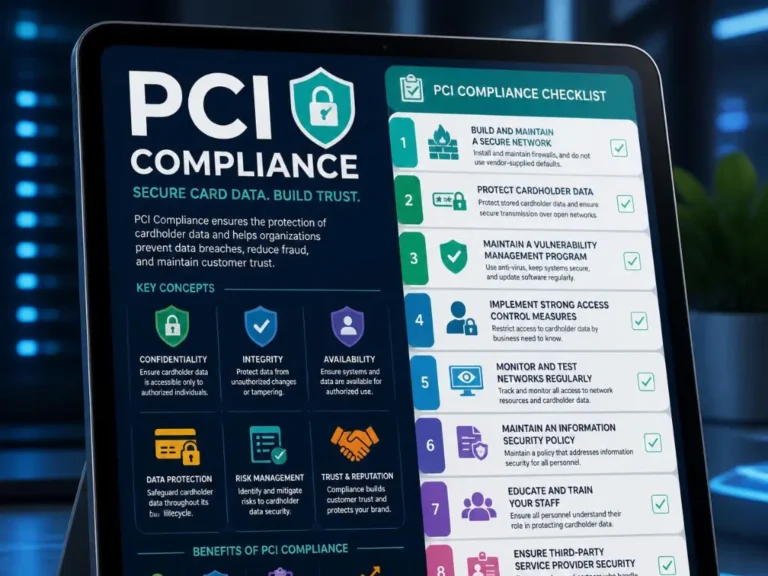
If you take card payments, this stops being a best practice conversation. PCI DSS version 4 requirement 11.2.1 requires you to test for the presence of wireless access points and identify all authorized and unauthorized ones at least once every three months. It applies even when you do not use wireless in the cardholder data environment and even when policy prohibits wireless, precisely because an access point is cheap to attach and hard to notice.
The scan is required regardless. If you are a retailer, restaurant, salon or medical practice taking cards in Seminole or Orange County, that is a quarterly obligation you may not currently be meeting.
On the HIPAA side, the issue is never the name. No regulation tells you what to call your WiFi. The issue is access control. If a patient in your waiting room can reach the practice management server from the guest network, that is a segmentation failure with real regulatory exposure, no matter how tasteful the network name is. We wrote about why the pieces matter less than the program in HIPAA Compliance Is Not a Binder.
Short answers to the questions I get asked
What is an SSID?
The WiFi network name your access point broadcasts, up to 32 characters, transmitted unencrypted whether or not the network itself is encrypted.
Should I hide my SSID?
Generally no. It does not hide the network from anyone with the right tools, it makes your employees’ devices announce the name elsewhere, and it creates support problems. Spend the effort on segmentation instead.
Does the guest WiFi password matter if the name is good?
Yes, and more than the name does. A long random passphrase is the single highest value control on a WPA2-Personal guest network. The naming discipline is there to remove the cheap shortcuts, not to replace the passphrase.
How often should we rotate the guest passphrase?
Quarterly is a reasonable default, and immediately after any staff departure where the passphrase was shared in writing. At high guest turnover, a captive portal beats a rotation schedule.
Do we even need guest WiFi?
Sometimes the honest answer is no. If visits are brief and cell coverage is good, the most secure guest network is the one you do not run.
Where our interest lies in this
You should know where I stand commercially. Harmony MSP sells managed IT and network security services to small businesses in the Orlando area, and wireless design, segmentation and network monitoring are part of what we bill for. When a business decides its network needs professional attention, we are one of the firms that benefits. I would rather say that plainly than pretend this is disinterested advice.
I will also say this: most of what is above is genuinely do it yourself work. With a competent business class firewall and access points, an owner or in house technician can rename the SSID, build a guest VLAN, turn on client isolation and lock down the management plane in an afternoon with the vendor documentation open. Nothing here requires hiring anybody.
The hard part is sustaining it: verifying isolation is still true six months and three equipment changes later, running and documenting rogue access point detection every quarter, keeping logs that will answer questions during an incident. That is where an outside firm earns its keep, and it is the honest case for using one.
If you want a second set of eyes on it
If you are not sure whether your guest network is genuinely separated from the network your business runs on, that is worth answering before someone else answers it for you. It usually takes under an hour to find out, and the finding is often that everything is fine.
We are based in Lake Mary and work with small businesses, law firms and medical and dental practices across Central Florida. If you would like us to look at your wireless setup, or you just want to talk through something in this article with someone who has done it a few hundred times, call us at (407) 720-6540. No pressure, and no obligation to become a client.
Sources
- CISA, Securing Wireless Networks (ST05-003)
- CISA, Securing Enterprise Wireless Networks
- NIST Special Publication 800-153, Guidelines for Securing Wireless Local Area Networks
- Erik Rye and Dave Levin, Surveilling the Masses with Wi-Fi-Based Positioning Systems, IEEE Symposium on Security and Privacy, 2024
- Apple Support, About privacy and Location Services in iOS, iPadOS, and watchOS
- Volexity, The Nearest Neighbor Attack, November 2024
- PCI Security Standards Council, PCI DSS v4.0.1, Requirement 11.2.1
- WiGLE, Wireless Geographic Logging Engine
- Efficient High-Speed WPA2 Brute Force Attacks (PBKDF2 key derivation and SSID salting in WPA2-Personal)
A note on sourcing: the geolocation, evil twin, PBKDF2 and Nearest Neighbor claims above come from the primary documents linked, not from secondary summaries. Where a figure could not be traced to a primary source, it was left out.