
If you own a business in the Orlando area, your technology is no longer a back-office concern you can afford to ignore until something breaks. It is the front line of your operation, your compliance posture, and, increasingly, your legal exposure. After more than 25 years working in network security and running a managed services practice, I can tell you that the single biggest predictor of whether a small business survives a cyber incident is not luck or budget. It is the quality of the managed IT services provider standing behind them before anything goes wrong.
The problem is that “managed IT services” has become a crowded, noisy category. Every provider in Orlando claims to offer 24/7 monitoring, fast response, and “enterprise-grade security.” The marketing is nearly identical. The reality behind it is not. Below is a practical, no-nonsense guide to what actually separates a competent, security-first partner from a help desk that resets passwords and hopes for the best. It is written for the people who feel the consequences most directly: small business owners, law firms, and medical and dental practices for whom a single breach can mean regulatory fines, malpractice exposure, and a permanent loss of patient or client trust.
Managed IT and managed security are not the same thing
The first distinction to understand is that “IT support” and “managed IT with security” are different disciplines, and a lot of providers blur the line on purpose.
Traditional IT support is reactive. Something breaks, you call, someone fixes it, and you get a bill. This “break-fix” model creates a perverse incentive: the provider makes more money when your systems fail. It also means nobody is watching your environment when you are closed, which is precisely when most ransomware detonates.
Modern managed IT services should be proactive and security-first by default. That means continuous monitoring, patching, and hardening happen in the background whether or not you have noticed a problem. At Harmony MSP, we treat security not as an add-on line item but as the foundation everything else sits on, because in 2026 there is no such thing as “just IT.” Every server, laptop, phone, and cloud account is an attack surface. If a prospective provider talks mostly about fixing tickets and rarely about preventing incidents, you are looking at a break-fix shop wearing a managed services label.
Here is a simple test. Ask a provider to describe what they do for you on a day when nothing is broken. If they struggle to answer, they are not managing your environment. They are waiting for it to fail.
Security has to be the foundation, not a feature
When you evaluate an Orlando managed IT provider, you should expect a specific set of security controls to be standard, not premium upgrades. In my experience, the following stack is the baseline for any business that takes its data seriously:
- Multi-factor authentication (MFA) everywhere. Passwords alone are effectively dead. MFA on email, remote access, and critical applications stops the overwhelming majority of account-takeover attacks. A provider who does not insist on this is a liability.
- Endpoint detection and response (EDR/MDR). Traditional antivirus recognizes known threats. Modern endpoint detection watches behavior and can catch novel attacks in progress, ideally with a human security team behind it responding around the clock.
- Immutable, tested backups. The phrase to listen for is “3-2-1”: three copies of your data, on two types of media, with one off-site and unchangeable. Just as important, backups must be tested regularly. A backup you have never restored from is a hope, not a plan.
- Email security and phishing defense. Roughly nine out of ten breaches begin with email. Proper SPF, DKIM, and DMARC configuration, plus advanced filtering, dramatically reduce what reaches your team’s inbox.
- Patch and vulnerability management. Unpatched software is the open window burglars climb through. Your provider should be closing those windows continuously, not quarterly.
- DNS and web filtering. Blocking malicious domains before a browser ever connects prevents a huge share of drive-by and phishing attacks.
- Ongoing security awareness training. Your people are both your greatest vulnerability and your best defense. A serious provider trains and tests your staff regularly, because technology cannot fully compensate for a well-crafted lure.
None of these should be surprises buried in a proposal’s fine print. If a provider treats fundamental protections like MFA or EDR as optional extras, that tells you where security sits on their priority list.
Compliance is where most providers quietly fall short
This is the section that matters most for the regulated practices reading this, and it is where the market gap in Orlando is widest.
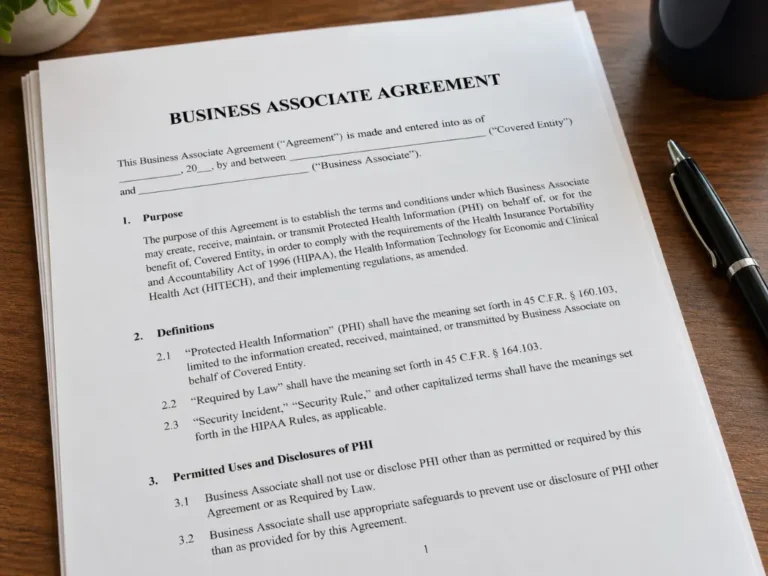
If you run a medical or dental practice, you are governed by HIPAA. Under the HIPAA Security Rule, you are required to conduct a formal risk analysis, implement administrative, physical, and technical safeguards, and maintain documentation that would survive an audit. Critically, any IT provider who can access, store, or transmit your patients’ protected health information (PHI) is legally a Business Associate. That means they must sign a Business Associate Agreement (BAA) and are directly accountable for their handling of that data.
Let me be blunt about this, because I have seen it cost practices dearly: a large number of general IT companies in Central Florida will happily service a dental or medical office without ever signing a BAA, without performing a proper risk analysis, and without configuring systems to HIPAA standards. If your provider cannot immediately produce a BAA and walk you through your risk analysis, you are non-compliant right now, and the liability lands on you, not them. Enforcement is real, penalties scale into six and seven figures, and “our IT guy handled it” is not a defense the Office for Civil Rights will accept.
Harmony MSP was built with this specialization at its core. We focus on HIPAA compliance and network security for exactly the kind of small practices that larger firms overlook and generalist providers are not equipped to protect. Compliance is not a checkbox we add at the end. It is the framework we design your environment around from day one.
Law firms operate under a parallel and equally serious set of obligations. The Florida Bar, following the broader trend in legal ethics, recognizes a duty of technology competence and a strict duty to safeguard client confidentiality. A data breach at a law firm is not merely an IT problem; it can be an ethics violation and a malpractice exposure. Firms handling privileged communications, financial records, and sensitive personal information need encryption, strict access controls, secure client portals, and defensible retention policies. Many also touch payment card data, which brings PCI obligations into the picture. Your MSP should understand this landscape and build to it.
And regardless of your industry, every Florida business is subject to the Florida Information Protection Act (FIPA), which requires notifying affected individuals of a data breach, generally within 30 days. A capable provider does not just help you prevent breaches; they help you respond correctly and lawfully if one occurs.
The bottom line: ask any prospective Orlando managed IT provider to explain, in plain language, how they will keep you compliant with the specific regulations that govern your practice. Vague reassurances are a red flag. Specific frameworks, documentation, and agreements are the sign of a partner who actually does this work.
Local presence and real response times matter
There is a reason I emphasize choosing an Orlando-based managed IT services provider rather than a distant national call center. When your systems go down, minutes matter, and there is no substitute for a partner who understands the local business community, can be on-site when a situation genuinely requires hands on hardware, and answers the phone as a known quantity rather than a ticket number in a queue three time zones away.
When you evaluate response times, get specific. Ask what their guaranteed response time is for a critical, business-down emergency versus a routine request, and make sure those commitments are written into the service level agreement (SLA). “We’ll get to it as soon as we can” is not an SLA. A defined response window that the provider is contractually accountable for is.
Local also means accountable. A regional provider who depends on referrals and reputation within Central Florida has every incentive to treat you well. That accountability is harder to find with a faceless national operation.
Transparency, documentation, and reporting
One of the clearest markers of a mature provider is how they document and communicate. You should have visibility into your own environment, not be held hostage by a provider who hoards the keys.
Look for a partner who maintains thorough documentation of your network, provides regular and readable reports on the health and security of your systems, and reviews that information with you rather than burying it in a portal you never open. You should understand, in business terms, what is being protected, what risks remain, and what investments will reduce them. A good provider makes you smarter about your own technology over time.
Equally important: you should own your data and your accounts. Be wary of any arrangement where the provider controls domain registrations, admin credentials, or backups in a way that would make it painful to leave. A confident, ethical MSP has no need to lock you in through control. They keep you through performance.
The questions to ask before you sign
To cut through the sales polish, here are the questions I would put to any Orlando managed IT services provider before signing an agreement. The answers reveal far more than any brochure:
- What do you do proactively on days when nothing is broken?
- What is your guaranteed response time for a critical outage, and is it in the SLA?
- Are MFA, EDR, and tested off-site backups included as standard, or priced separately?
- If you touch our patient or client data, will you sign a BAA, and can I see your standard one?
- How do you specifically keep a practice like mine compliant with HIPAA (or Florida Bar / PCI) requirements?
- When was the last time you actually restored a client from backup, and how long did it take?
- Who owns our data, admin credentials, and backups: us or you?
- How do you train and test our staff against phishing?
- What does your incident response process look like if we are breached?
- Can you provide references from businesses in my industry here in Central Florida?
Asking these questions is the easy part. Verifying the answers is harder, so I wrote a step-by-step companion guide on how to vet IT companies in Orlando before you sign.
Red flags worth walking away from
A few warning signs should end the conversation quickly. Be cautious of any provider who leads with the cheapest possible price, because security done properly has real costs and rock-bottom pricing usually means corners are being cut somewhere you will not see until it is too late. Be equally cautious of long, punitive contracts that lock you in without corresponding performance guarantees, of providers who cannot clearly explain their security stack, and of anyone who dismisses compliance as someone else’s problem. The right partner earns your business month after month through results, not through contractual handcuffs.
Why veteran-owned makes a difference
I want to close on something that is more than a marketing line for us. Harmony MSP is veteran-owned, and that background shapes how we operate every day.
Military service instills a security-first mindset that is difficult to teach any other way. In the military, you plan for the threat before it materializes, you build in redundancy because failure has real consequences, you follow disciplined procedures precisely because shortcuts get people hurt, and you take responsibility for the mission rather than making excuses. Those instincts translate directly into protecting a business’s data. When we assess your environment, we are thinking like the people whose job it once was to anticipate and defend against a determined adversary, because that is exactly what a modern cybercriminal is.
For the small business owners, law firms, and medical and dental practices we serve across Orlando and Central Florida, that discipline shows up as thoroughness, follow-through, and a genuine sense of duty toward the people who trust us with their systems. We do not view your practice as an account to be managed. We view your protection as a mission we have accepted.
Choosing the right partner is a business decision, not just an IT one
The managed IT provider you choose will have their hands on the most sensitive parts of your business: your patient records, your client files, your financials, your communications. That decision deserves the same scrutiny you would apply to hiring a key executive. Prioritize security over price, insist on compliance expertise that matches your industry, demand transparency and real response commitments, and choose a local partner who is accountable to you and to the Central Florida community.
If you are a small business owner, attorney, physician, or dentist in the Orlando area and you are not fully confident that your current IT setup would hold up to a breach or an audit, it may be worth a conversation. At Harmony MSP, we are always happy to talk through your situation, answer questions, and help you understand where you stand, with no pressure and no obligation. If that would be useful, you can reach us anytime at (407) 720-6540. Whether or not we end up working together, you deserve to know your business is protected.